Carpet Extraction Schedules for Corporate Offices:
What Most Vendors Underbid
A carpet that looks fine from eye level can be carrying enough embedded soil to cut years off its fiber life. By the time you see the damage, the replacement conversation has already started.
Corporate office carpet needs daily vacuuming, monthly interim extraction, and quarterly hot-water extraction. Most vendor proposals include only annual extraction. That is one extraction event when the correct program calls for four.
Direct Answer
A correct corporate office carpet maintenance program has three layers: daily vacuuming to remove surface soil before it migrates into the pile, monthly interim extraction or encapsulation to remove mid-level accumulated soil, and quarterly hot-water extraction to reach the backing and restore fiber condition. Most vendor proposals include only annual hot-water extraction. The gap is not a minor difference in frequency. It is a structural failure in the program that accelerates fiber deterioration, shortens carpet life by 30 to 50%, and creates visible quality failure in traffic lanes before the carpet reaches half its expected lifespan. See the full floor type matrix in our commercial floor care guide.
Floor Care
Reduction in carpet service life caused by under-extraction programs. Annual-only extraction in corporate offices accelerates fiber deterioration and forces replacement years ahead of schedule.
Most vendors propose annual extraction and win on price. The carpet does not fail immediately. It fails at year 7 instead of year 14, and the vendor is long gone.
Why Carpet Hides Failure the Longest
Carpet is uniquely deceptive as a commercial floor surface. It hides soil better than any other material in the facility. The fibers trap and conceal grit, dust, and organic contamination at the surface, in the mid-pile, and at the backing. Walking through a corporate office, a carpet that looks acceptable can be carrying 30 to 40 times its own weight in embedded soil below the visible surface.
That embedded soil is abrasive. Every footstep works it through the fiber, cutting and fraying the pile from the inside out. The damage is invisible until the carpet reaches a condition where the pile is physically worn and the backing becomes visible. At that point, the carpet is already years past the point where extraction could have reversed the trend.
This is the mechanism behind premature carpet failure in corporate offices. The carpet is not worn out from age. It is ground out from soil abrasion that a correct extraction program would have prevented. The visible result looks like a 12-year-old carpet. The carpet is 7 years old. The replacement estimate arrives. Nobody connects it to the extraction schedule.
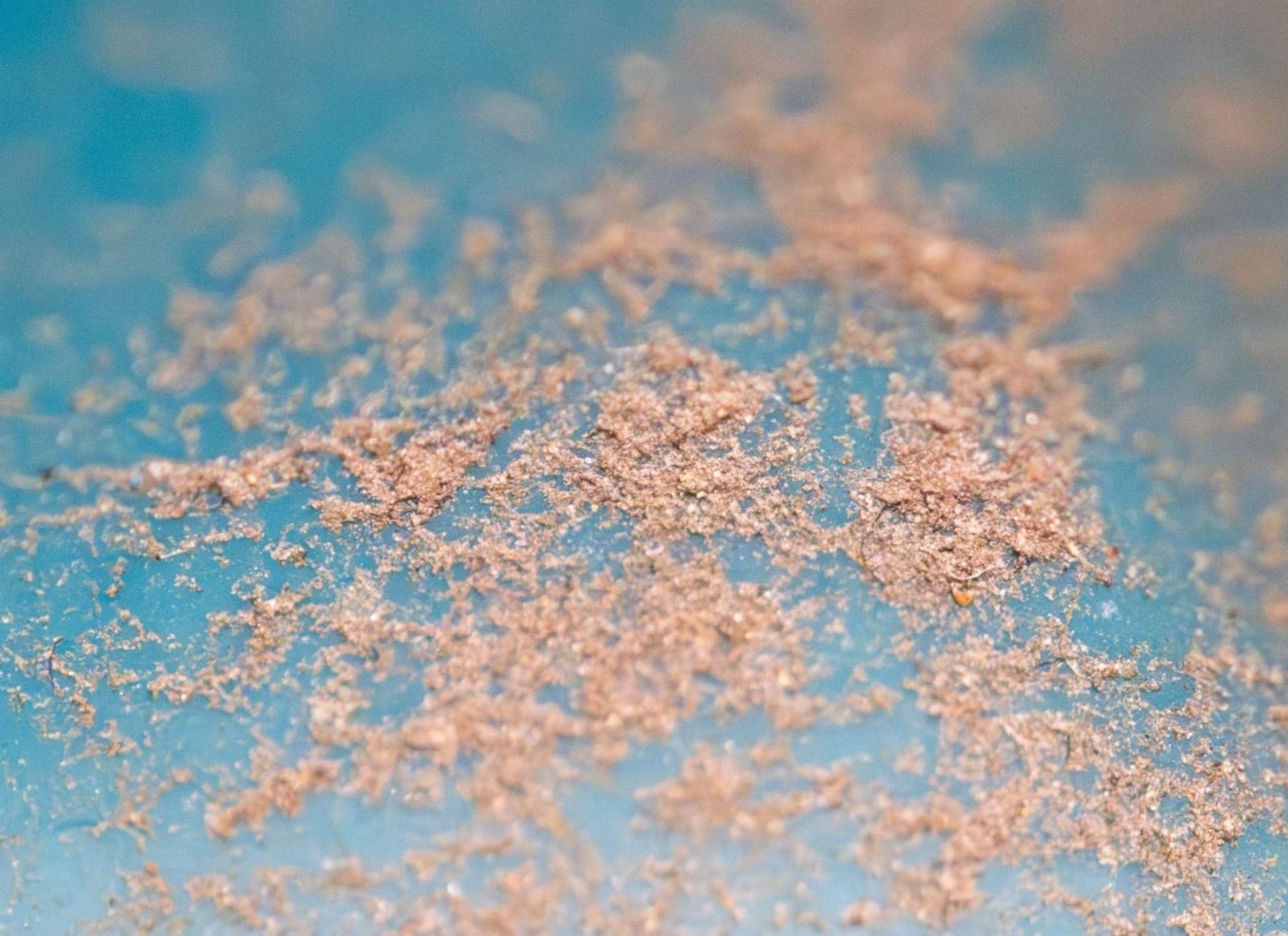
Debris pulled from commercial office carpet during a restorative extraction event. This material was below the visible surface.
The Three-Layer Carpet Maintenance Program
| Layer | Method | Frequency | What It Removes |
|---|---|---|---|
| Surface maintenance | Upright vacuum with beater bar or CRI-certified commercial vacuum | Daily (all traffic areas), 3x/week (light traffic) | Surface soil, grit, debris before it migrates into pile |
| Interim extraction | Low-moisture encapsulation or dry compound extraction | Monthly (main corridors), quarterly (private offices) | Mid-pile accumulated soil, re-suspended surface soil, light stains |
| Restorative extraction | Hot-water extraction (truck-mount or portable) | Quarterly (high traffic), semi-annually (moderate traffic) | Deep-pile soil, organic contamination at backing, allergens, biofilm |
| Spot treatment | Spot cleaner appropriate to stain chemistry | As needed within 24 hours of spill | Individual stains before they set permanently into fiber |
Want a personalized estimate for your facility?
Our calculator builds a custom cleaning cost estimate based on your square footage, facility type, and frequency.
Try the Free Calculator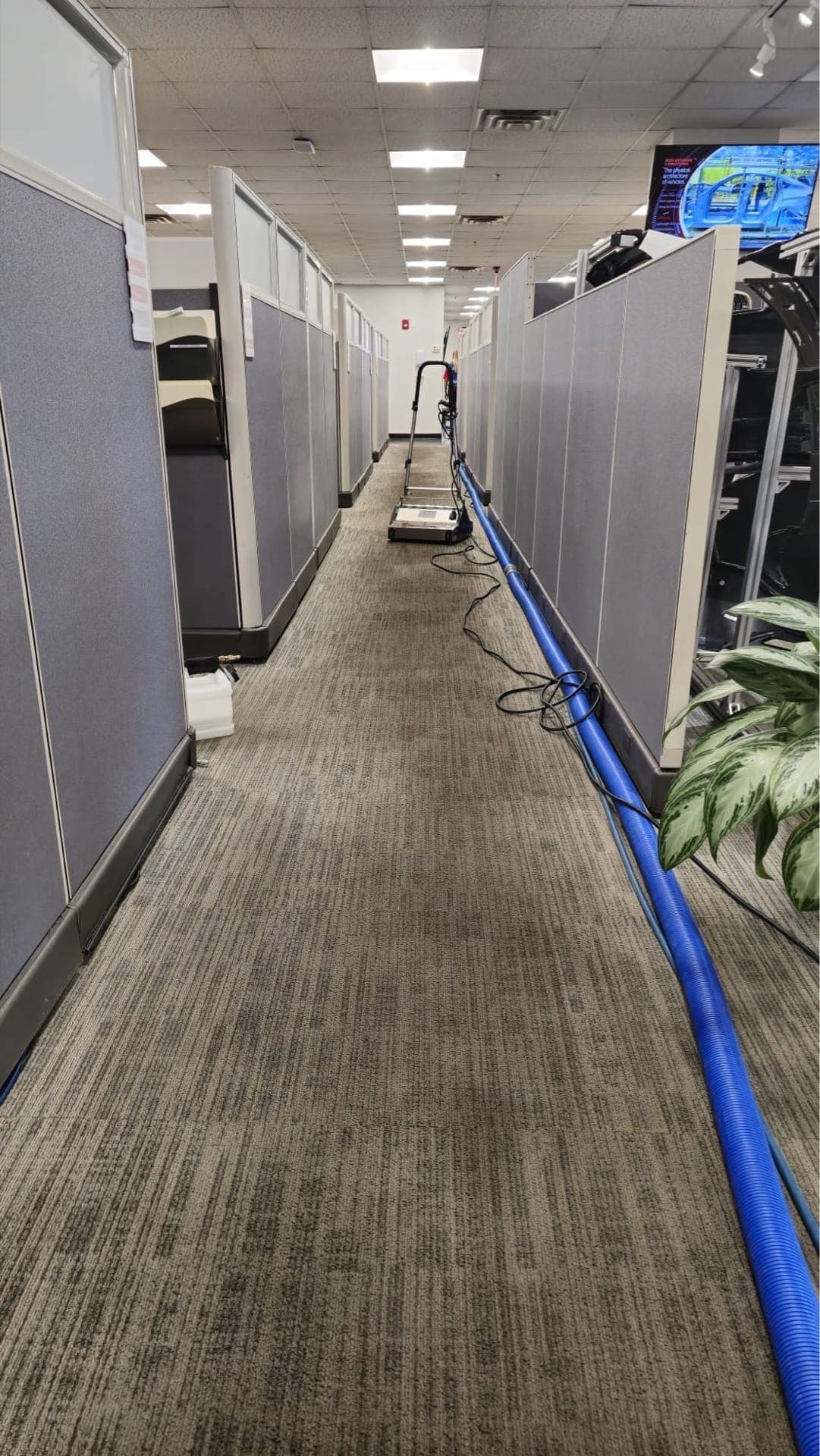
Before
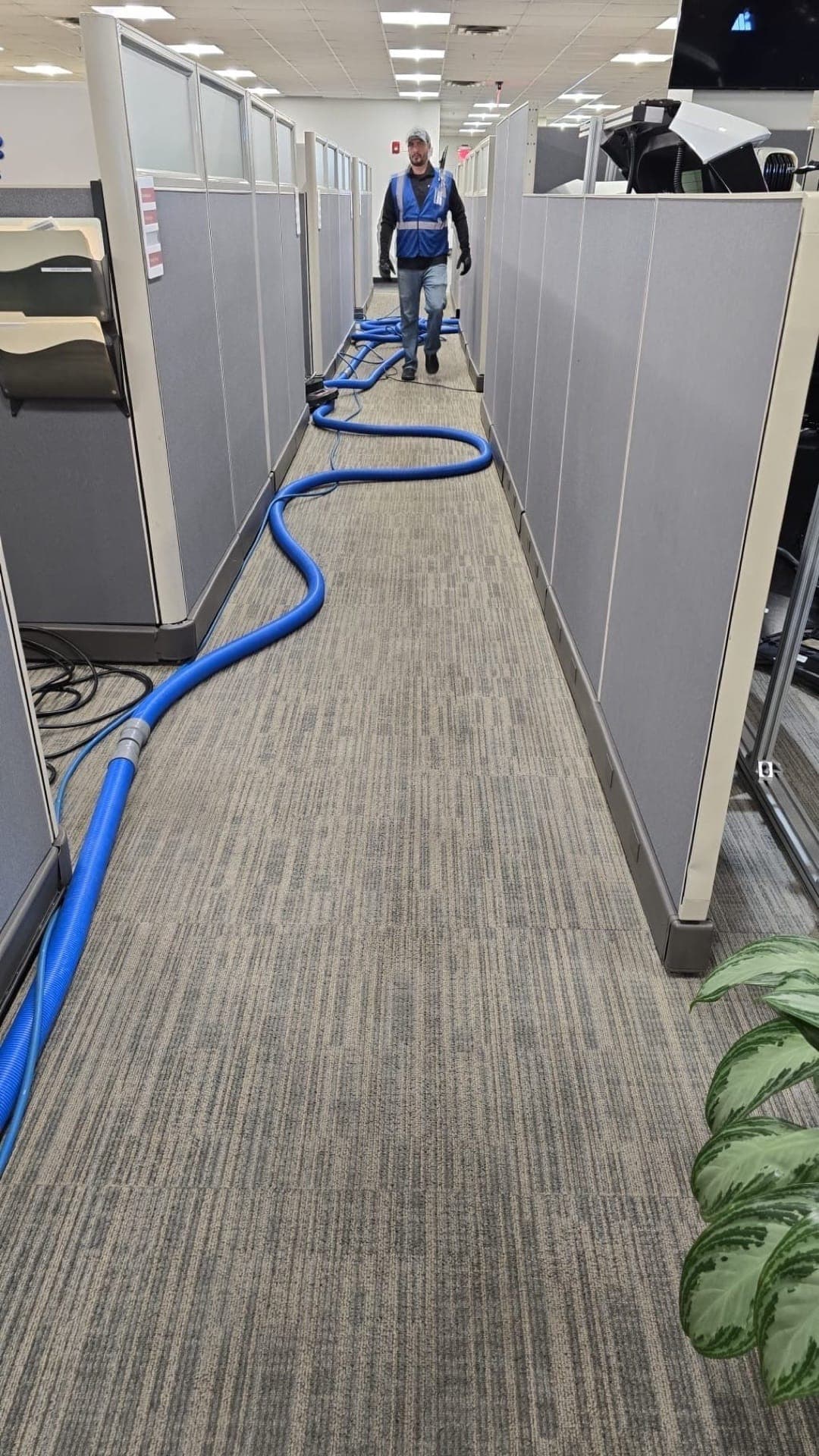
After
Why Vendors Underbid Extraction
Carpet extraction is a cost-bearing service that requires equipment, product, labor time, and scheduling coordination to deliver correctly. The annual extraction proposal that most vendors include in a standard janitorial contract costs them one day of equipment time per year per account. That is a manageable cost to include in the base contract.
A quarterly extraction program is four times that cost. Monthly interim extraction is 12 additional service events per year. Including the correct program in the base contract requires pricing that reflects the actual service delivery cost. Vendors who want to win on price drop the extraction frequency to annual or semi-annual, do not explain the consequence, and submit a lower number.
The facility manager compares proposals on total cost. The lower-frequency proposal wins. Three years later, the carpets in the main corridors look like they are at end of life. The vendor offers to upsell a "deep clean" at additional cost. The facility manager pays it. The real problem, which is that the contract extraction schedule was never sufficient, is never surfaced.
When reviewing carpet maintenance proposals, the extraction schedule should be a mandatory line item. If the proposal does not specify frequency explicitly, assume it is annual. Ask what the cost of quarterly extraction is. Compare the full-program cost, not just the base contract number.
"What most corporate offices are paying to replace carpet, they could have spent maintaining it. The soil that destroys carpet fiber lives deep in the pile, below what vacuuming reaches. Extraction gets it. By the time carpet looks bad, it is often past the point where extraction saves it."
Austin Jones, CEO, Millennium Facility Services
FM Intelligence Series
Free research reports for facility leaders
We publish in-depth guides on costs, contracts, compliance, and operations. No fluff. Written from the field.
The Interim Extraction Step That Makes Quarterly HWE Work
Hot-water extraction is the gold standard for carpet deep cleaning. It reaches the backing, flushes the pile, and removes what nothing else can get. But it works much better and produces a faster drying carpet when the interim extraction program is in place between full extractions.
Interim encapsulation applies a cleaning agent that encapsulates soil particles in the mid-pile, crystallizes on drying, and is then vacuumed away. It is a low-moisture process that does not require long drying times and can be done during off-hours in a live facility. Done monthly, it removes the soil accumulation that would otherwise build up between quarterly hot-water extraction events and grind into the fiber.
Facilities that have only quarterly HWE without monthly interim encapsulation see three months of unrestricted soil abrasion between extractions. Facilities with monthly interim encapsulation see three months with soil load managed every 30 days. The fiber condition difference is visible and measurable over a two to three year period.
Zone-Based Extraction Schedules for Corporate Offices
Not every area of a corporate office needs the same extraction frequency. Traffic patterns determine soil load. The program should be designed by zone, not applied uniformly across the entire carpet footprint.
Main corridors and lobby entries
Monthly interim encapsulation. Quarterly hot-water extraction. Daily vacuum.
Highest soil tracking, most visible area, sets the quality standard for the building.
Open office and workstation areas
Monthly interim encapsulation. Quarterly hot-water extraction. Daily vacuum.
High foot traffic, food and drink proximity, 8-10 hours of daily use. Soil load is high.
Private offices
Quarterly interim encapsulation. Semi-annual hot-water extraction. 3x/week vacuum.
Lower traffic, less tracking, but still accumulates soil at the backing over time.
Conference rooms
Monthly interim encapsulation (or after major event). Quarterly hot-water extraction. Daily vacuum.
Intermittent but concentrated use. Food service presence. Board-level appearance standard.
Break rooms and cafeterias with carpet adjacency
Monthly hot-water extraction. Weekly interim encapsulation. Daily vacuum.
Food and liquid spill risk is highest here. Organic soil at the backing creates odor and biofilm issues quickly.
The Cost of Getting Extraction Right vs Getting It Wrong
A quarterly hot-water extraction program plus monthly interim encapsulation on a 30,000 square foot carpeted office costs roughly $8,000 to $14,000 per year in additional extraction services above the base contract. That is the correct number to compare against the cost of carpet replacement at end of life.
Commercial carpet on a correct extraction program reaches 12 to 15 years of service life before replacement is economically necessary. On an annual-extraction-only program, fiber failure in traffic lanes becomes visible at 6 to 9 years. On the same 30,000 square foot footprint, carpet replacement runs $3 to $6 per square foot installed, or $90,000 to $180,000 for the full floor. Replacing it at year 7 instead of year 14 is $90,000 to $180,000 in accelerated capital expense.
The correct extraction program costs $8,000 to $14,000 per year. Over seven additional years, that is $56,000 to $98,000. The avoided early replacement is $90,000 to $180,000. The math is not close.
Related services
Get facility insights that save money
Join facility managers who get our operational intelligence. No spam. Unsubscribe anytime.
Or download our free research reports without signing up.
Frequently Asked Questions
Hot-water extraction quarterly in high-traffic zones and semi-annually in light-traffic private office areas. Monthly interim encapsulation in all areas where hot-water extraction is quarterly. Daily vacuuming everywhere. Most vendor proposals include only annual extraction. A single annual extraction event is insufficient to prevent the soil abrasion that drives premature carpet fiber failure.
Interim encapsulation applies a cleaning agent that surrounds and crystallizes soil particles in the mid-pile, which are then vacuumed away after drying. It is a low-moisture process with a short drying time, suitable for use in occupied facilities. Hot-water extraction injects hot water and cleaning solution into the carpet backing and extracts it with a powerful vacuum, removing deep-pile soil, organic contamination, and allergens. Both are necessary components of a layered program. Encapsulation cannot substitute for hot-water extraction, and hot-water extraction alone without interim encapsulation leaves 11 months of unmanaged soil abrasion between events.
Extraction services are a significant cost to deliver correctly. Annual extraction fits within a base contract price that wins on competitive bids. Quarterly extraction costs four times as much to deliver and requires a higher contract price that loses to lower-frequency proposals if the facility manager is evaluating only on total contract cost. The correct approach is to spec the extraction frequency explicitly in the RFP and require vendors to price the correct program, then compare proposals on that basis.
Insufficient extraction frequency combined with inadequate daily vacuuming. Soil that is not removed at the surface migrates into the pile. Soil in the pile is not removed by extraction events that are too infrequent. Accumulated soil in the pile acts as sandpaper, cutting fibers with each footstep. The damage is invisible until the pile is already physically worn. At that point, restoration is not possible and replacement is the only option.
Pull a section of carpet in a main traffic corridor and look at the backing. If the backing shows gray or brown soil staining and the pile feels stiff or matted, the program is inadequate. In a correct extraction program, the backing is clean and the pile recovers after foot traffic. You can also request a moisture reading after your last hot-water extraction to confirm proper soil suspension and extraction. Ask your vendor to show you an inspection photo of the carpet backing at their last extraction. If they cannot produce one, the inspection is not happening.
Yes, in nearly every corporate office scenario. The additional program cost of quarterly hot-water extraction plus monthly interim encapsulation runs $8,000 to $14,000 per year on a 30,000 square foot facility. The avoided early replacement cost of 5 to 7 years of additional carpet life runs $90,000 to $180,000. The math favors the correct program by a wide margin. The only scenario where it may not is a facility planning to recarpet in the near term regardless of current condition.
Commercial upright or backpack vacuums with HEPA filtration rated for commercial carpet pile depth. Consumer-grade vacuums lack the motor power to extract soil from commercial carpet pile effectively. The vacuum must be run at the correct speed: moving too fast over carpet leaves soil in place. Daily vacuuming with an underpowered or consumer machine does not substitute for the soil extraction that a properly specified commercial vacuum provides.
With proper equipment and technique, hot-water extraction in a commercial office carpet should produce dry conditions within 4 to 8 hours. Facilities scheduling extraction after business hours will typically have dry carpet before the next business day. Extended drying times of 12 hours or more indicate that too much water was applied during extraction, the carpet backing was oversaturated, or air circulation is insufficient. Oversaturation can accelerate mold growth in the backing and accelerate delamination.
Find out what your carpet extraction schedule is actually costing you.
We review your current carpet condition by zone, identify where the program is under-extracting, and model the replacement timeline versus a correct extraction schedule. Most facilities can extend carpet life by 5 to 7 years with the right program.
No obligation. A clear picture of your carpet program and what the next decade looks like.

Founder & CEO, Millennium Facility Services
Austin Jones founded Millennium Facility Services and personally walks the facilities his teams service across the Southeast.