Autonomous Cleaning Technology:
The Future Is Already Running on Our Floors
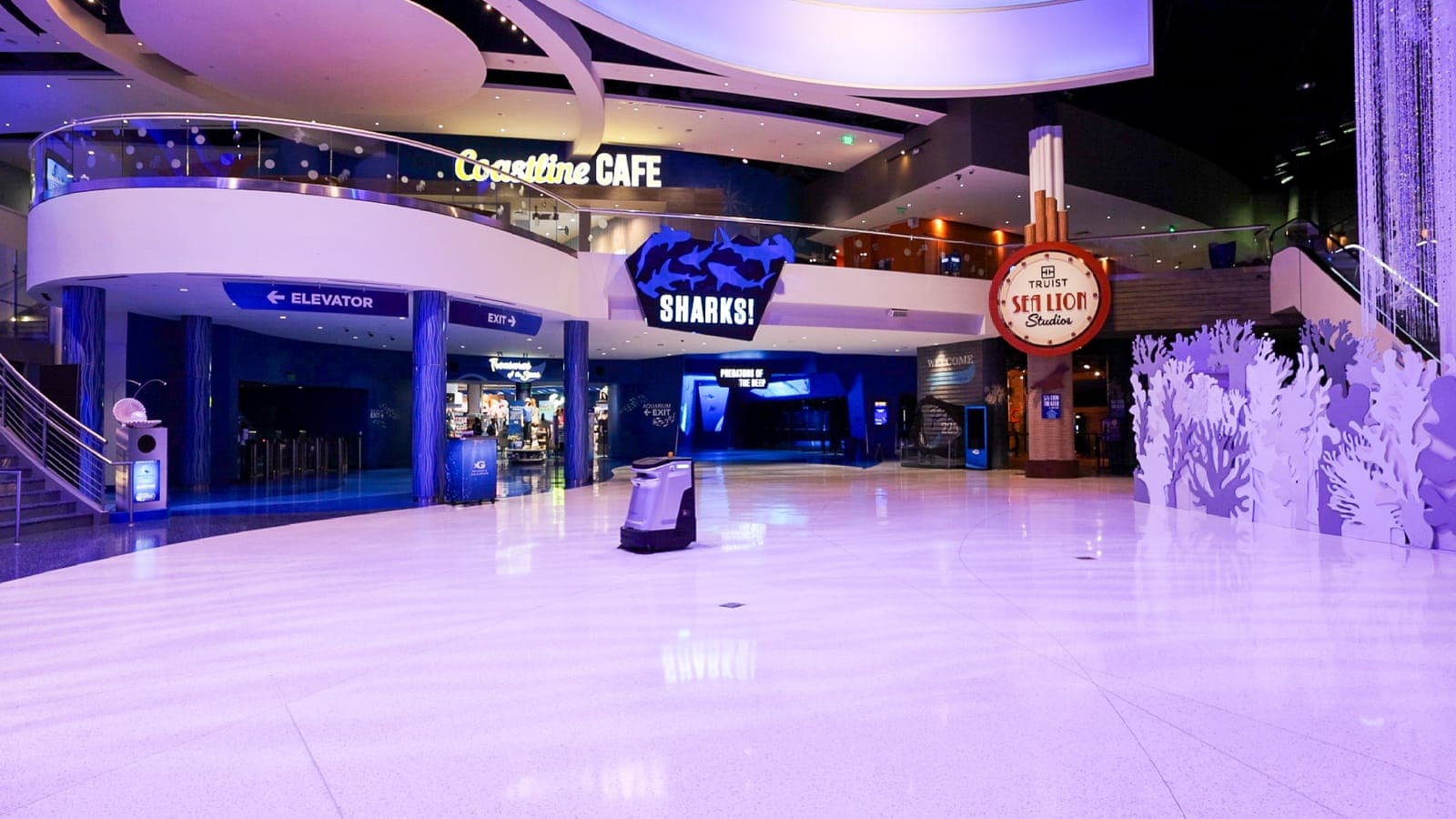
Millennium Facility Services deploys autonomous cleaning technology across large commercial and institutional facilities in the Southeast, including autonomous floor scrubbers operating across more than 550,000 square feet at Georgia Aquarium. We are not watching this technology from the sidelines. We run it, measure it, and build the cost-per-square-foot math for every account that asks. Autonomous cleaning, digital twin training, smart chemical governance, and IoT restroom monitoring: this is the complete technology stack that modern facility operations require.
The industry crossed the line. We crossed it first.
ISSA, the global cleaning industry trade body, declared in early 2026 that robotic floor cleaning has officially crossed the adoption threshold. The question for facility managers is no longer whether to deploy autonomous equipment. It is which platforms deliver the best cost-per-square-foot math for their specific floor type and shift structure. Millennium answered that question operationally before the industry finished asking it.
We operate autonomous floor scrubbers at Georgia Aquarium, one of the largest indoor public attractions in the United States, spanning more than 550,000 square feet of mixed floor surfaces with high public traffic during operating hours and intensive cleaning windows overnight. That operational context gives us something most cleaning companies cannot offer: real performance data from real environments, not a sales demo on a controlled warehouse floor.
BrainOS Clean 2.0 with SelfPath AI
Brain Corp's latest navigation platform eliminates the manual route-training step entirely. Instead of requiring a technician to walk each robot through every new area, SelfPath AI generates and optimizes cleaning paths automatically. The result is faster deployment, higher coverage consistency, and significantly lower setup labor. This platform rolled out to compatible commercial scrubbers in May 2026.
Tennant X16 SWEEP
Tennant's first purpose-built autonomous industrial sweeper, launched in April 2026, is designed for continuous multi-shift operation in manufacturing and distribution environments. Dust-shielded LiDAR, a smart-sense hopper, and an autonomous recharging dock mean the machine can run unattended across full operational shifts. This is the platform the industry has been waiting for in high-debris environments.
Karcher KIRA B 200
The world's first autonomous scrubber certified to IEC 63327, the international standard for autonomous cleaning equipment in public-traffic spaces. This certification matters because it answers the liability and insurance question that has blocked autonomous deployment at public-facing accounts. For facilities with guests, patients, or customers present during cleaning hours, IEC 63327 is the risk management document risk managers need.
Gausium via SoftBank Robotics America
SoftBank Robotics America expanded its Gausium portfolio in early 2026 with three US-distributed models: the Omnie for large-space scrubbing, the Phantas 1.3 for mixed-use sweep and scrub, and the V40 2.0 for vacuum operations. Gausium is currently the only Chinese-origin robotic cleaning platform with clean US distribution, avoiding the 145% tariff exposure that has blocked most direct China procurement.
“We run autonomous Cenobot scrubbers at Georgia Aquarium across 550,000 square feet. We are not evaluating this technology. We are operating it every night.”
Austin Jones, CEO, Millennium Facility Services
The hardest labor problem in facility management just got a robot
Restroom cleaning is the single highest-labor task at most large facilities. It is also the category that generates the most complaints, the most service failures, and the most inconsistency between shifts. Two platforms now offer credible autonomous restroom cleaning, and Millennium is evaluating both for pilot deployment at high-traffic anchor accounts.
The Primech AI Hytron is 15.7 inches wide, narrow enough to enter standard restroom stalls. It uses a six-axis robotic arm and proprietary ozone-enhanced electrolyzed water to clean and sanitize surfaces without chemical inputs, achieving independently verified bacterial reduction above 99%. It won TechRadar Pro Picks at CES 2026 and is available through a robotics-as-a-service monthly model. Singapore origin means no tariff exposure under the current US trade structure.
The LionsBot T1 debuted at InterClean Amsterdam 2026. It uses dual-arm manipulators and self-sanitizing tools designed specifically for restroom fixture cleaning. Like the Hytron, it is Singapore-origin and operates on a RaaS deployment model. Early performance data from the InterClean debut is being tracked by our operations team.
For high-traffic venues like Georgia Aquarium and World of Coca-Cola, restroom labor is the largest cost driver in the cleaning program. A credible autonomous restroom platform reduces that cost while improving sanitation consistency, the two outcomes that matter most to guest experience and ESG reporting. We are not recommending either platform to clients until we have run one in a live account environment.
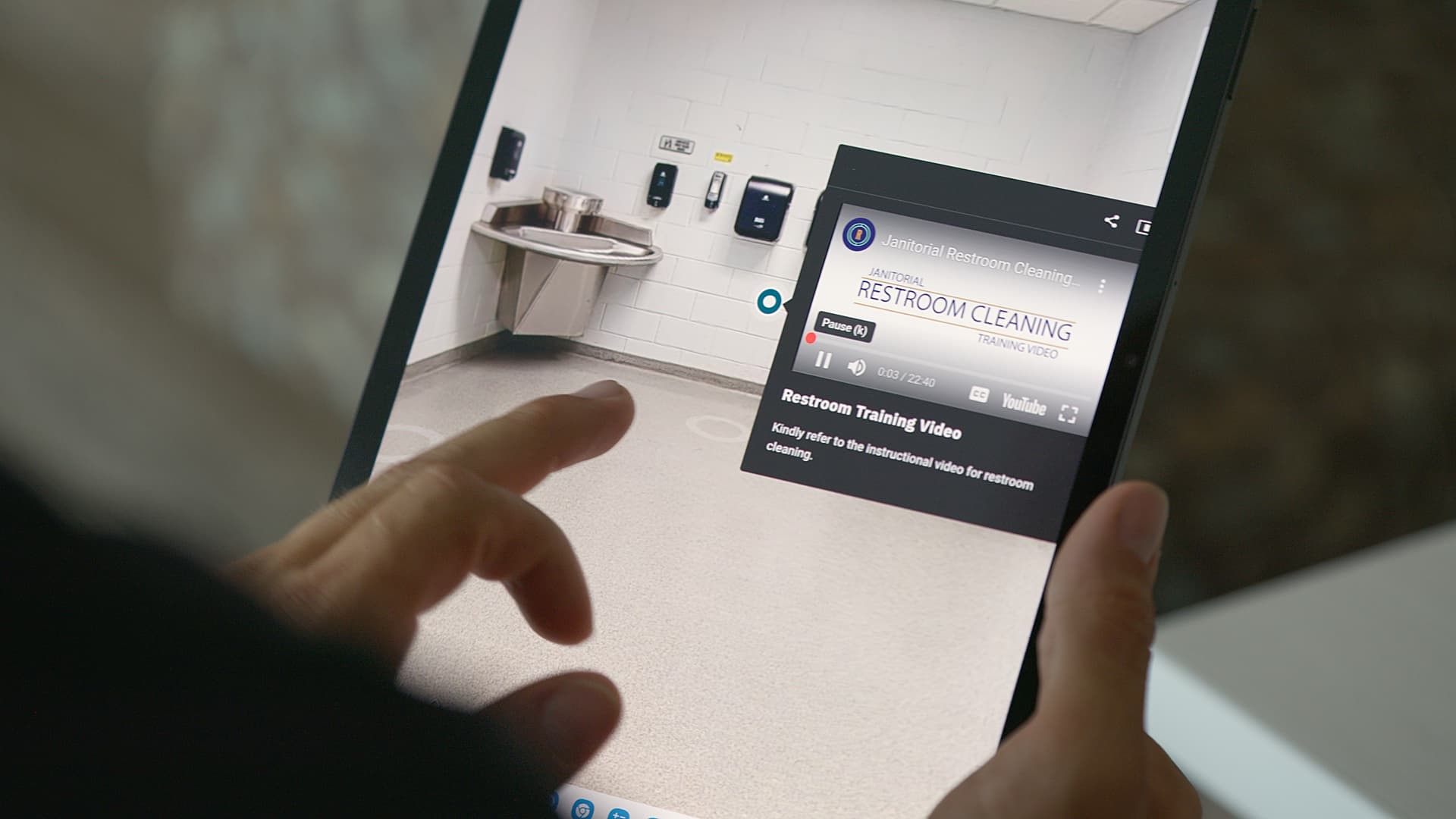
Millennium tracks restroom service quality through IoT sensors and digital inspections. Autonomous platforms will integrate into the same reporting layer.
Every crew member walks the building before their first shift
Before autonomous machines navigate a facility, humans need to understand it. Millennium uses Matterport 3D scanning to build precise digital replicas of the facilities we manage. New crew members complete virtual walkthroughs before setting foot on-site. Learn more at our virtual training program.
Matterport 3D Facility Scans
We scan every managed facility into a navigable 3D model. Every zone, restroom, corridor, and equipment room is mapped. New crew members explore the facility digitally during onboarding, reducing errors and cutting ramp-up time from weeks to days.
MatterTag Protocol Instructions
Task-specific instructions are embedded directly into the 3D model at each location. A crew member entering a restroom cluster in the digital twin sees the exact procedure for that space, including chemical selection, dwell time, and inspection standards. Instructions live at the location, not in a binder on a break room shelf.
Autonomous Equipment Mapping
The same facility scans that power crew training also support autonomous equipment deployment. When we deploy a robotic floor scrubber, the facility map is already documented. This reduces machine setup time and ensures the robot's zone coverage matches the actual cleaning scope.
“The future of facility cleaning is not replacing people with robots. It is freeing your crew to focus on the work that requires human judgment while machines handle the repetitive square footage.”
Austin Jones, CEO, Millennium Facility Services
PFAS is a sales weapon for compliant vendors. Non-compliance is a contract risk.
Maine banned PFAS in commercial cleaning products effective January 1, 2026. In the same quarter, nearly 100 related bills were introduced across 17 states. Federal GSA custodial contracts now require Green Seal GS-37, GS-41, or GS-53 certification, or EPA Safer Choice status, both of which prohibit PFAS-class chemicals. Millennium is proactively auditing its chemical inventory against these standards. Vendors that have not done this audit will fail institutional procurement screens in 2026 and 2027.
Ecolab Fill & Clean
Concentrated mobile dispensing that replaces 16 standard 32oz RTU bottles with a single vessel. Auto shut-off prevents over-dilution, which removes the ability for field teams to freelance chemical mixing. Lower cost than current pilot-scale robotics and deployable within days of approval.
Green Seal Compliance
Green Seal re-published its cleaning product standards in April 2026, explicitly prohibiting approximately 12,000 PFAS-class chemicals. Millennium is verifying compliance on every product in the active chemical inventory. This documentation is available to clients on request for ESG reporting.
Electrolyzed Water Systems
Several autonomous restroom platforms, including the Primech Hytron, use electrolyzed water rather than chemical inputs. This eliminates chemical transport, storage, and disposal cost while achieving verified bacterial reduction above 99%. Chemical-free cleaning at the point of use is both a cost reduction and a compliance solution.
Solid Format Chemistry
Zero-plastic-packaging solid chemistry formats from companies like Diversey eliminate single-use plastic from the cleaning supply chain entirely. For accounts with ESG reporting requirements at institutions like Georgia Aquarium, the ability to document plastic reduction from cleaning operations is a measurable sustainability metric.
Smart Dispenser IoT
IoT-enabled dispensers from platforms like Kimberly-Clark Onvation SmartFit use time-of-flight sensors and open API outputs to signal depletion before a restroom runs out of product. This converts porter routes from time-based to signal-based, reducing labor hours while improving guest experience. Learn more in our post on smart dispensers and IoT consumable tracking.
Probiotic and Enzyme Chemistry
Probiotic cleaning formulations remain active for up to 21 days after application, reducing the frequency of chemical reapplication in high-odor zones like aquarium holding areas and manufacturing break rooms. Fewer chemical applications per month reduces cost and reduces chemical exposure for both crew and building occupants.
Why autonomous is cheaper than headcount at scale
The case for autonomous floor cleaning is not about technology adoption for its own sake. It is cost-per-square-foot math. At large facilities, the labor required to run a ride-on floor scrubber across hundreds of thousands of square feet every night represents a significant fixed cost. An autonomous scrubber operating unattended during the same window at a robotics-as-a-service monthly rate can reduce that cost substantially, freeing labor budget for detail cleaning, restrooms, and service areas where human judgment is irreplaceable.
The economics improve further when the robot runs multiple shifts. An autonomous scrubber does not require overtime pay, does not call out sick, and does not vary in performance between shifts. At facilities with 24-hour or 20-hour operating days, the machine can run two or three cleaning passes per 24-hour period, compressing the cost-per-clean even further.
Millennium builds this analysis for every account where autonomous deployment is under consideration. We measure current floor labor hours, map the floor to determine autonomous coverage percentage, and model the RaaS monthly cost against the current labor spend. If the math does not work, we say so. If it does, we have the operational experience to deploy and manage it.
Every square foot is tracked, inspected, and measured. That data is what makes cost-per-square-foot analysis credible.
Labor cost typically ranges from $4,000 to $8,000 per month depending on shift structure, benefits, and overtime. Human operators also vary in coverage speed, pattern consistency, and corner coverage.
Current-generation RaaS pricing for commercial autonomous scrubbers ranges from approximately $1,800 to $3,500 per month depending on the platform and facility size. The machine runs its programmed route consistently every shift, every night.
The most effective deployments use autonomous equipment for open field areas and route corridors while trained crew handles restrooms, entries, detail cleaning, and areas requiring judgment. Total cost is lower. Quality is higher.
Typical cleaning company vs. Millennium
“GPS verification is not a feature we added. It is how we built the company. If we cannot prove a crew showed up and completed the scope, we do not invoice for it.”
Austin Jones, CEO, Millennium Facility Services
Proven at Georgia Aquarium
“Georgia Aquarium has been extremely pleased with the janitorial services provided by Millennium. Their responsiveness and flexibility around our operational schedule has been essential to maintaining our high standards.”
“Millennium understood from day one that our operation doesn’t pause for cleaning. They built a program around our shifts, and we’ve never had to wonder whether the work got done.”
The complete technology stack
Autonomous cleaning is one layer of a full technology program. Every link below connects to a piece of the system Millennium runs across 5M+ square feet today.
Autonomous cleaning by industry
Autonomous Cleaning Technology: FAQ
Common questions from facility managers evaluating autonomous cleaning programs.
Autonomous cleaning technology refers to robotic floor scrubbers, sweepers, and restroom cleaning systems that navigate and operate without a human operator guiding each pass. These machines use LiDAR sensors, AI path planning, and computer vision to clean large commercial floors, restrooms, and industrial spaces consistently and efficiently. Millennium Facility Services operates autonomous floor scrubbers across large institutional accounts including Georgia Aquarium.
Yes. Millennium operates autonomous floor scrubbers at Georgia Aquarium, which spans over 550,000 square feet. Autonomous equipment runs during off-hours to maintain large floor surfaces while our crews focus on detail work, restrooms, and areas that require human judgment. We are actively evaluating next-generation robotic platforms for additional anchor accounts.
At large-format facilities, autonomous floor scrubbers can significantly reduce the labor hours required for routine floor maintenance. The cost advantage comes from operating the machine unattended on a programmed route, freeing crews for higher-value tasks. The break-even point depends on facility size, floor surface complexity, and how many shifts the robot can run per day. Millennium builds the cost-per-square-foot math for each account before recommending autonomous deployment.
The Karcher KIRA B 200 is the world's first autonomous floor scrubber certified to IEC 63327, the international safety standard for autonomous cleaning equipment operating in public-traffic environments. This certification addresses the liability question that has previously blocked autonomous cleaning at public-facing accounts like aquariums, entertainment venues, and convention centers. It means risk managers at these facilities have an internationally recognized safety standard to point to.
BrainOS Clean 2.0 is Brain Corp's latest autonomous navigation platform for commercial floor scrubbers. The SelfPath AI module within it eliminates the manual route-training step that previously required a technician to walk the robot through every new area. The robot generates and optimizes its own cleaning paths automatically, which reduces deployment time significantly and improves coverage consistency. It rolled out to compatible machines in May 2026.
Two platforms have entered commercial availability: the Primech AI Hytron, a fully autonomous restroom cleaning robot that uses electrolyzed water instead of chemicals and has been deployed in large hospitality environments, and the LionsBot T1, which debuted at InterClean 2026. Both are in early commercial deployment phases. Millennium is evaluating both for pilot programs at high-traffic anchor accounts where restroom labor is the largest cost driver.
PFAS are a class of synthetic chemicals found in many industrial and commercial cleaning products. Maine banned PFAS in cleaning products effective January 1, 2026, and nearly 100 related bills were introduced across 17 states in the same quarter. Federal GSA custodial contracts now require Green Seal or EPA Safer Choice certification, both of which exclude PFAS-class chemicals. Facilities with institutional clients or ESG reporting requirements are increasingly requiring PFAS-free cleaning programs from their vendors.
Digital twin training uses Matterport 3D scanning to create a precise virtual replica of a facility. Cleaning crews walk through the digital twin during onboarding to learn every zone, restroom, and service area before setting foot in the building. Millennium uses MatterTag protocols to embed task-specific instructions directly into the 3D model at each location. This cuts new crew ramp-up time and produces more consistent results from shift one.
Ready to see the math on autonomous cleaning?
We will walk your facility, map your floor zones, and show you exactly where autonomous equipment changes the cost-per-square-foot. No obligation. No sales pitch on technology you do not need. Just the analysis.